


Understanding Wine with Tartrate Crystals Podcast
Around the turn of the year, most people have plenty of time. Time to dedicate to their hobbies – in the case of Winetory readers, this hobby is certainly wine.
Do you already have the latest Gault-Millau wine guide, the Eichelmann guide, and various books on wine knowledge on your coffee table, nightstand, or bookshelf? But you've never found the time to read them? Perhaps the Johnson Wine Atlas was under the Christmas tree this year, and you resolved to finally refresh your wine knowledge and educate yourself so you're no longer standing clueless in front of the wine shelf or so you can better understand the friendly wine salesperson at your local wine shop. But that was also on your list last year, and you never found the time to sit down and pore over the books.
Now imagine being able to expand your wine knowledge every morning on your way to work, at the gym, or while walking the dog. I assume that sounds interesting to many, and that was precisely my motivation for launching the Weinstein podcast at https://weinstein-podcast.podigee.io .
 Image: Jan Eißmann in the vineyard
Since I started working part-time giving wine seminars and providing wine consulting, I've been committed to continuous learning. However, I lacked a good podcast that I could use to constantly expand my wine knowledge. So I decided to create one myself!
This means that I have to sit in my small recording studio and can't get information while driving, but this regular commitment offers me the chance to regularly engage with my passion, to constantly learn more, and above all, to gain access to a new, interesting, and friendly community: the wine lovers of the German-speaking world.

Image: The top 3 most popular episodes of 2019: 'Tips for buying wine', 'Introduction to Italy' and 'Pinot Noir'
My goal is to learn as much as possible about wine myself and to share that knowledge with my audience. Whether it's the fact that Hungary now boasts an exciting and vibrant wine scene, building on its long winemaking tradition before the Soviet Union's planned economy, or that the "Kabinett" designation in Germany requires a minimum must weight of 73 degrees Oechsle. But above all, I want to inspire wine enthusiasts and accompany them on their personal wine journey.
Every two weeks, I release a new episode on various wine-related topics. Among other things, I talk about buying wine in the supermarket, the secrets of different winemaking methods, wine regions, wine styles, grape varieties, and I conduct interviews with fascinating people from the wine industry. In this episode, you'll get a year-in-review of the 2019 wine year as well as a brief summary of the year for the Weinstein podcast.
So if you want to learn more about wine and get a taste of all areas of the wine scene, then you've come to the right place with my podcast on
Exactly right. Instagram offers almost daily updates on wine: tasting notes, suggestions, and of course, pictures!
I would be delighted to inspire you with my work and look forward to your messages and exchanging ideas with more wine enthusiasts.
I wish you a wonderful new year and an exciting wine tour in 2020!
About the author Jan Eißmann
Jan studied English for teaching at the University of Trier, a wine region, and continuously expanded his knowledge of wine alongside his studies. As a wine expert, he holds WSET (Wine & Spirit Education Trust) Level 3 certification. On June 18, 2018, his first 18-minute podcast, "The Visual Impression," was released on Spotify. Since then, 67 more episodes have followed. He finds inspiration for his stories on regular wine tours through Germany, Austria, Italy, and France. Jan also shares his knowledge in his wine seminars, which can be booked through his website.
- Website: weinsteinblog.de
- Instagram: instagram.com/Weinsteinpod
- Facebook: facebook.com/Weinsteinpod
What exactly is cream of tartar?
Tartaric acid salts form cream of tartar. This can happen during the storage of wine and grape juice. The salt crystals settle at the bottom of the container or on the cork. The solubility of cream of tartar decreases with decreasing temperature.
The substance in question is a mixture of sparingly soluble salts of tartaric acid, essentially potassium hydrogen tartrate and calcium tartrate.
Tartaric acid has no harmful effects on humans. It feels slightly gritty in the mouth at first. When rubbed between the teeth, the tartaric acid dissolves in the saliva.
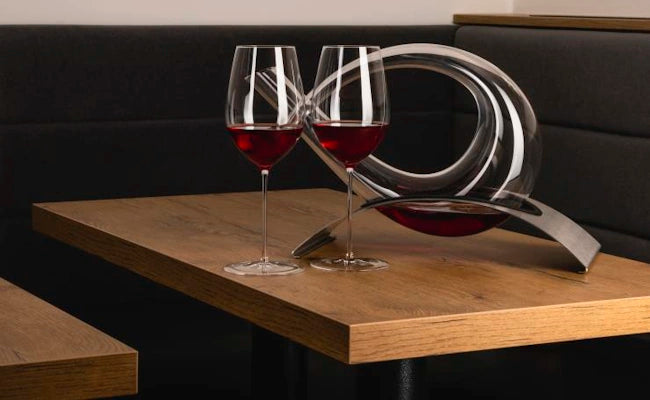
Wines, especially red wines, but also white and rosé wines, are decanted to separate the wine from the tartrate crystals. Wine is a natural product, and tartrate crystals are not a defect or a sign of inferior quality.

Written by Wolfgang Angeli


Leave a comment
This site is protected by hCaptcha and the hCaptcha Privacy Policy and Terms of Service apply.