

Element Gin - The Making of a Brand

New ideas do not emerge from nothing. No concept without a foundation. In the case of Element Gin, it is the combination of two long-known aspects that had not previously been considered together: the combination of the ancient Greek doctrine, according to which all existence on earth is based on the mixture of the four elements of fire, water, air, and earth, with the product spirit.

The Background
The idea for a four-part "element gin" arose during the tasting of essences. The small distillate samples of individual botanicals, which are used for blending gin and their various combination possibilities, literally invited this. The goal was to create four fundamentally different gins, which would mutually enhance each other through their differences and embody an individual gin aroma. Each of these gins was intended to exhibit the essence of one of the four mentioned elements. What constituted the core nature of an element was the guiding question for the subsequent experiments. The development, which will be discussed in more detail below, can be divided into three main steps.
First, the tasting panel was introduced to the idea and the topic of gin. This involved benchmarking commercial gins and evaluating them. In the next step, individual botanical gins were distilled and sensorially tasted to assign them to the respective elements. The project was conceived as a bachelor's thesis at the Weincampus Neustadt and was funded by the German Federal Ministry of Education and Research within the framework of "Funding Individual Study Paths (FIS)" for "Research-Based Learning."
First Step
The thirty-member panel, consisting of students, employees, and doctoral candidates from Weincampus Neustadt, was first introduced to the topic, informed about the planned course of the project, and invited to provide comments and criticism. The inclusion of a direct exchange between the panel and the project leaders ensured a collaborative effort and development.

Subsequently, the following nine different commercial gins were sensorially evaluated based on three questions:
- Gin Sul Hamburg Altonaer Spirituosen Manufaktur O,5 l
- Whitley Neill London Dry Gin 0,7l
- Thomas Sippel Palatinatus Dry Gin 0,5l
- Hendrick’s Gin 0,7l
- Clockers Gin 0,5l
- Gin 27 Premium Appenzeller Dry Gin 0,7l
- Hoos London Gin 0,5l
- Monkey 47 Schwarzwald Dry Gin 0,5l
- Liebl Bavari Dy Gin 0,7l
This was followed by a classification of gin intensities into the elements, scaled from 1 to 9, to check the implementation potential of the four-element gin idea in relation to the existing market and the current presence of such flavors. The second question concerned the intensity of the five most important gin aromas according to Montserrat on a scale of 1-5.

The last check was performed using a CATA procedure. CATA stands for "Check All That Apply", meaning that the assessors must assign their sensory impressions to given attributes. In this case, 23 attributes were queried. Following the tasting, the panel participants were given a themed association task. They were asked to assign attributes, taste characteristics, emotions, colors and shapes to the four elements and to collect specific associations for the connection between drink and element. The classification of the tasted, commercial gins into the imagined element concept showed that it is hardly possible to link these gins with the four elements. The testers were too
disagreeing in their assignments of the gins to the elements. They thus do not fit into the new concept. Element Gin had to be different.
The green line in Graph 2 corresponds to the assignment to the elements, the red lines mark the intensity of the five most important gin aromas, and the blue line illustrates the attributes of the CATA procedure.

The differentiation of the group Fire/Earth and the group Water/Air is clearly shown by their juxtaposition in the graph. However, the assignment of aromas within the groups Water/Air and Fire/Earth presented difficulties: these pairs were partly "provided" with the same botanicals. The group Water/Air is rather assigned fruity and floral aromas, such as lemon, as well as the attributes simple and innovative. The group Earth/Fire is initially linked with significantly more attributes. Spices such as cardamom, anise, and pepper are worth mentioning, as well as the characteristic "herbal aroma". In the association study, the elements Air/Water were assigned relatively similar attributes such as simple, refreshing, and fruity. Earth was attributed the properties deep and herbaceous, while Fire was attributed sharpness and intensity. From this, conclusions could be drawn about alcohol content, the
quantity of botanicals and the flavors of the elements. Thus, for Earth/Fire, more botanicals and higher alcohol values should be used, while for the Water/Air group, the values were reduced.
Second Step
In the second step, the focus was on specific aromas and their elemental affiliation. For this purpose, 37 botanicals were selected from previously collected sensory data, typical gin botanicals, and the experimental spirit and ingenuity of an expert panel, and each was individually distilled. On a small scale (still content 0.5 liters), these botanical spirits were distilled in the laboratory using a glass, water-cooled distillation apparatus. For this, the botanical quantities were individually adjusted according to the degree of comminution of the respective botanical, weighed, and macerated for 24 hours in 60 vol.% alcohol.
Before tasting the samples, the panelists were presented with the results of the previous sensory tests to introduce them to the topic of assigning tastes to the four elements and to prepare them for the tasting. The samples were rated by the tasters for intensity on a scale of 1-5 for each of the four elements. Below, only the most significant evaluable botanicals for each element are listed.
- For the element Fire, the predominant botanicals are chili, ginger, grains of paradise, cardamom, coriander, orange peel, hop blossom, blood orange, rosehip, patchouli blossom, and anise.
- The element Water is associated with lemongrass, olive leaves, lime mint, eucalyptus, hibiscus flower, cardamom, peppermint, rose aroma, grains of paradise, lemon peel, rosemary, and juniper.
- The element Earth includes thyme, rosehip, licorice root, juniper, angelica root, marjoram, rosemary, pine needles, coriander, patchouli, marigold blossom, hop blossom, fennel, anise, and chamomile blossom.
- The element Air is assigned: peppermint, lemon balm, rose aroma, lemon peel, lavender, eucalyptus, blood orange, pomegranate, lemongrass, and fennel.
From this data, specific botanicals could be assigned to the individual element gins. These preparations were necessary to proceed with the test blending of the gins.
Third Step
At the beginning of the third work step, the results of the previous sensory evaluations were combined to develop various recipes. The table with the specific, significant aromas from the second tasting had the most important influence on this. But the results of the association study and the first tasting were also incorporated. An expert panel tested countless recipes on a small scale using the essences created in the second experiment. A long and difficult process, which was worked on with great care and patience. For each element, two test variants were distilled, which differed in the concentration of botanicals.
The version with the low concentration of botanicals consisted of 250 g of juniper and the corresponding amount of botanicals. The other version consisted of 500 g of juniper and also double the amount of botanicals. The weighed botanicals of the less intense version accounted for approximately 20% of the weight of the 96% vol alcohol. The botanicals were macerated for 20 hours in 5 liters of 60% vol alcohol and then distilled together in a 30-liter pilot plant at the DLR Neustadt an der Weinstraße. This was done without a column and without fractionation. The resulting raw spirits were adjusted to 40% vol alcohol and presented to the panel for tasting, then tasted.
The panelists had to answer three questions regarding the gins. Among other things, the question of preference and the five most important gin aromas on a scale of 1-9. Furthermore, an assignment of the gins to the four different elements based on their intensity was necessary. The distinction between Air/Water and the Earth/Fire group was very positive during the assignment, while deficits in differentiation still existed within the mentioned groups. The elements Water/Air and Earth/Fire seemed to be difficult to distinguish from each other.

In Graph 3, only the first two parameters are shown. It is noticeable that the preference of the subjects decreased with increased spice, anise, or licorice aroma. The Air and Water gins, with their distinct citrus characteristics, were at the top of the preference. The lighter, more floral, and more lemony the gin, the more the subjects liked it. It must be mentioned that the samples were tasted neat. Furthermore, it was observed that the versions with high concentration, despite a doubling of botanicals, showed no striking differences. It should be noted that gin is mainly used as a base for mixed drinks, and herbal aromas in a Gin & Tonic can certainly present themselves better than they could in a direct, neat comparison.
The Refinement
Due to some errors in the first distillation, such as the lack of fractionation, and the results of the tasting of the element gins, a further refined version was created. In this version, three bubble caps were used. The resulting spirits were more harmonious and had shed their rough, raw, and unfinished character. The middle cut was separated up to an alcohol content of 78% vol alcohol. The feints were divided into small fractions and individually sensorially checked. Furthermore, the use of botanicals was reduced. From the available results, it could be seen that a high usage was unnecessary. Recipes were adjusted to eliminate disturbing aromas of certain botanicals, which now stood out due to the finer distillation technique. All these measures led to much finer spirits, which could no longer be sensorially checked within the scope of the project.
Equipment
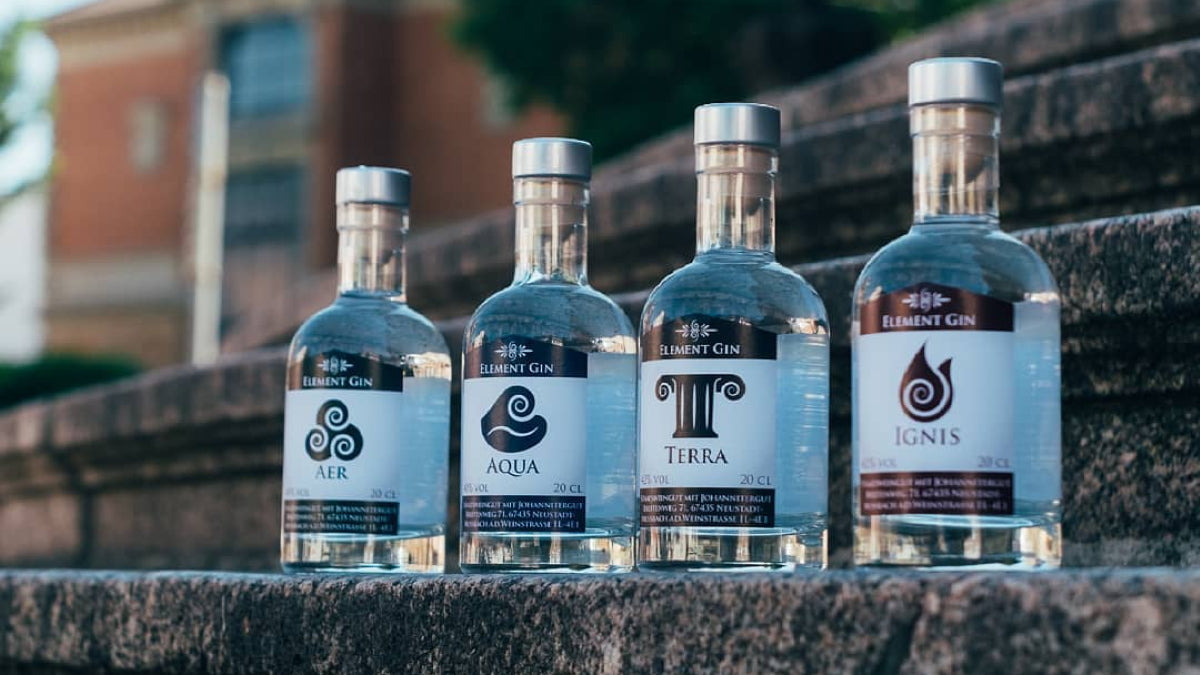
An important factor was the further development of the concept to a holistic external presentation of the product. The Four-Elements Gin project borrowed from existing gin design elements, such as the minimalist and puristic design of many gin labels, and yet created a new design concept through its reference to the four elements. It is reflected in all components of the product's equipment and packaging, from the labels to the packaging.

The connection to the four elements and ancient Greek culture is clearly established through the design. The upper part of the labels symbolizes the roof of a temple, the middle part is dedicated to the actual sanctuary in the form of the respective element, and the lower section forms the base. The novelty is now the linking of the four elements with a beverage that brings their essence closer to the connoisseur in a unique sensory way.
The back label, which lists the recognizable components and aromas of the gin in the product, ensures an increased connection to the element and the product itself. It becomes more accessible. The packaging continues the concept of combining antiquity with modern minimalism. A carton of Element Gin will contain one bottle of each element with a 200 ml capacity. The high "play value" of the gins is due to their diverse experimental uses.

The consumer can mix the gins together and thus incorporate their personal preferences. They can tailor the drink exactly to their taste. In line with the current popularity of DIY (do-it-yourself), which in the broadest sense also applies to combinations of beverages, this is an important marketing advantage. All these measures make the finished product more than a conventional gin. The four-element package becomes an experience. Through active tasting and experimenting, the product becomes the customer's own creation. This increases identification with it. Element Gin clearly shows: to establish successful products on the market, in addition to stories about the product, an experience should also be conveyed. Because a product must offer emotional added value.
- Text and graphics: Philipp Hofmann
- Image: Dominik Hezinger

Passende Produkte


Written by Wolfgang Angeli

Leave a comment
This site is protected by hCaptcha and the hCaptcha Privacy Policy and Terms of Service apply.