



Riesling - the queen of white wines
Varietal characteristics of Riesling
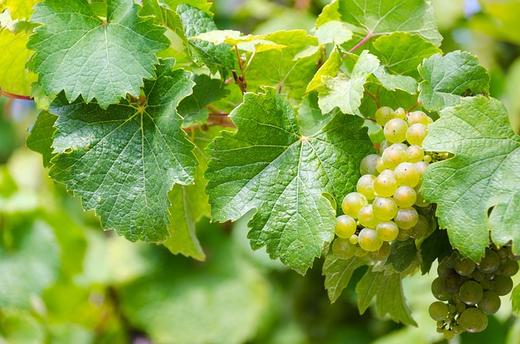
The Riesling grape is small and rather inconspicuous; the grapes grow to a maximum medium size (in contrast to Müller-Thurgau or Dornfelder grapes are densely packed with berries, often shouldered on the vine, round, greenish-yellow, and, when exposed to sunlight, golden-yellow to yellowish-brown. A striking feature is the delicate black speckling. However, this variety demands a specific growing location. Cultivation is limited to cooler climates due to the extremely long ripening period (120-180 days between flowering and harvest).
Damage from downy or powdery mildew is rare. Black spot disease is also hardly ever seen. Red blotch can occur more frequently in shallow, steep vineyards that warm up easily. The Botrytis cinirea fungus is desirable on ripe grapes for producing the best selections. If applied at the wrong time, it destroys the grapes as grey mold. Pests do not discriminate between grape varieties.
These grape varieties have Riesling as their parent or father variety: Bacchus, Kerner, Müller-Thurgau, Scheurebe, Albalonga, Aris, Rieslaner, Rotberger
Origin and History: The question of the origin of the Riesling grape variety is closely linked to the problem of the origin of our cultivated grape varieties in general. Around the turn of the last century, it was still debated whether, in prehistoric times, viticulture had spread to Germania from the ancient civilizations of the Afro-Asian and Mediterranean regions. The myths surrounding this are as varied as the speculations about its origins. Very early on, it was already suspected that Riesling It bears a certain resemblance to the Amminesian grape described by Pliny the Elder (agricultural writer, 23-79 AD). King Louis the German (843-876) is said to have cultivated Riesling. They were planted on the Rhine for the first time.
Another theory is that the Riesling The theory that it developed from the wild grapevine Vitis Vinifera Varita Silvestris, which is still native to the Rhine region, has been significantly challenged in recent years by molecular biological studies conducted by the State Institute of Viticulture and Enology in Klosterneuburg. According to current knowledge, it is now considered certain that the parent varieties are Heunisch (a medieval high-yielding grape) and a seedling of Traminer.
The first documented mention of the grape variety: in 1430, it is reported that the Rusling vineyard was located near Worms; in 1435, near Rüsselsheim; in 1464/65, on the Moselle; and in 1477, in Alsace (and in Germany until the 17th century). These documents attest to the cultivation of Riesling on the Rhine and... Moselle .
The actual The Riesling boom came after the “Little Ice Age” in the Middle Ages through the decree of the Trier Elector Clemens Wenzelslaus in 1787: “…to uproot all inferior grape varieties and replace them with Riesling”
The first Riesling boom: The events surrounding the late harvest rider (Karl the Late Harvest Rider) from Johannisberg Monastery, who, with the prince-bishop's permission, arrived in the Rheingau several weeks late for the start of the harvest, thus triggering a very late harvest of botrytized grapes, which resulted in an excellent wine. These events are now associated with the beginning of the deliberate production of botrytized grapes and the associated sweet wines.
Secularization under Napoleon brought church property into private hands, and within a century, German Rieslings reached a price level that made their producers very wealthy. The palatial villas and estates of old, large winegrowers still bear witness to this boom at the beginning of the 20th century.
Synonyms : Klingelberger (Ortenau), Riesling Renano; White Riesling, Riesling Rössling, Rösslinger, Riesler, Rieslinger Rheinriesling, Moselriesling, Rheingauer, Johannisberger, Hochheimer, Niederländer, Gräfenberger, Kastellberger, Karbacher Riesling, Kleinriesling, Klein-riesler, Weißer Kleiner Riesling
Cultivation and cultivated area (international and national, as of mid-2004):
Vineyard area (Vineyard area in %)
Germany 20,627 ha 61.9
Australia 4,256 ha 12.8
France 3,350 ha 10.1
USA 1,700 ha 5.1
Austria 1,643 ha 4.9
New Zealand 636 ha 1.9
Canada 440 ha 1.3
South Africa 347 ha 1.0
Chile 288 ha 0.9
Total 32,857 ha 100%
Germany:
Rheinhessen 2,930 ha 10.4
Palatinate 4,896 ha 21.0
Baden 1,203 ha 7.5
Württemberg 2,102 ha 18.3
Moselle 5,242 ha 57.7
Franken 277 ha 4.1
Near 1,038 ha 25.2
Rheingau 2,430 ha 78.2
Saale-Unstrut 44 ha 7.0
Ahr 37 ha 6.8
Middle Rhine 316 ha 68.0
Hessian Mountain Road 217 ha 49.8
Saxony 62 ha 15.1
Total Riesling area in Germany: 20,797 ha = 20.38% of the German vineyard area
Taste style : The acidity of Riesling This grape variety can be considered the heart of this grape, as it is the bearer of the fruity Riesling style. The wine is characterized by finesse, elegance, minerality, and a rich interplay on the palate.
Its unsurpassed bouquet often evokes peaches, citrus fruits, apricots, exotic fruits, as well as numerous other, mostly light-colored, ripe fruits.
In summary : Attempts are being made to cultivate Riesling in almost every country around the globe. Riesling is cultivated here. However, Riesling prefers a cool climate and poor soil. The slate soils and steep slopes in Germany allow it to become an inimitable, radiant representative of its variety.
Often copied – never equaled! Although already in climate zone B, very fine results are achieved in Austria in the Wachau region on the north bank of the Danube and in the Spitzer Graben and Traisental valleys. Since 2006, the Traisental DAC has been the first Austrian Riesling DAC.
In the USA, Riesling It is cultivated in the Five Finger Lakes region of northern New York State, on the East Coast, in the Williamette Valley in Oregon, and in the Yakima and Columbia Valleys in Washington on the West Coast. In Canada, cultivation is limited to the Okanagan Valley and the Niagara Peninsula in the state of Ontario.
Riesling is found in Australia along the Margaret River, in the Barossa Valley, the Eden Valley, and the Clare Valley. In New Zealand, the 600 hectares of vineyards are spread across all growing regions. The vineyards in Chile and South Africa largely originate from German immigrants, but after the red wine and Chardonnay boom, they remain relatively obscure.

Written by Wolfgang Angeli


Leave a comment
This site is protected by hCaptcha and the hCaptcha Privacy Policy and Terms of Service apply.