

9 Facts About Wine Knowledge
1. HOW IS WINE MADE?
WHITE WINE
First, the grapes are destemmed, either mechanically or by hand, and then crushed. This creates a thick mixture of pulp, skins, juice, and seeds – the must. This mixture rests for several hours and is then pressed – resulting in the so-called grape juice.
After the must has been sulfured to prevent spoilage, it is transferred to fermentation tanks. In these tanks, fermentation begins with the addition of specific yeast cultures. During this process, the sugar is converted into alcohol. Once fermentation is complete, the wine is separated from the lees. Some wines then mature for several months in stainless steel tanks or in new and old wooden barrels, mostly made of oak.
RED WINE
The production process for red wine differs primarily in the sequence of the individual steps. For red wine, it is not the must, but the grape skins that are fermented. The red wine is also imparted with the grape skins. Only after fermentation is the red wine pressed and subsequently aged or stored.
2. WHERE DOES ROSÉ GET ITS PINK COLOR?
Rosé wines are produced from red wine grapes using the same process as white wine. However, the must is left to macerate for a short time. This allows the rosé to absorb pigments from the grape skins, giving it its characteristic pink color.
3. MUST GOOD WINE AUTOMATICALLY BE EXPENSIVE?
This question cannot be answered in general terms, because there are many factors that influence the price of wine.
Premium wines, for example, are often produced in small quantities and require more work and time than many other wines. But harvest yield, the winery's reputation, and the harvesting method also affect the price.
But all of this doesn't answer the question of whether expensive equals good, especially since "good" is a very subjective term. In our opinion, you should definitely invest more than €5 in a good wine and, above all, make sure it suits the occasion.
4. WHY CAN ONLY SOME WINES AGE?
Whether a wine has aging potential depends primarily on its ingredients. Generally speaking, more red wines than white wines are suitable for aging.
So what is it about some wines that allows them to be stored for decades? The answer lies in tannins – the more tannins a wine contains, the longer it will keep. However, a high tannin content also means that the wine needs this time to develop. In its first few years, a wine suitable for aging can be almost undrinkable. Only over time does it become smoother and softer. This is due to the decrease in tannins, whose structure changes in such a way that larger molecular complexes settle to the bottom of the bottle as sediment.
There are a few other influencing factors, such as sulfides, acidity and alcohol content, which also affect the storage potential.
5. How to store wine?
You've decided to save a bottle of wine for a special occasion for an extended period? But how can you guarantee that it will remain in good condition?
The simplest option is, of course, a wine refrigerator. However, these are expensive and take up a lot of space. So, if you follow a few simple rules, you shouldn't have any problems storing wine even without a wine refrigerator.
Find the coolest spot in your apartment or house. Ideally, it should be dark and slightly humid – around 60% to 80% humidity. Make sure the wine isn't exposed to large temperature fluctuations. The temperature should be between 10 and 15 degrees Celsius.
6. WHAT IS A CUVÉE?
A cuvée is generally understood to be a blend of different grape varieties, vineyard sites, or vintages. However, "blend" here doesn't necessarily mean that the winemaker uses up leftover wine from their stock and mixes it together. Rather, the term "blend" refers to the composition of several grape varieties that results in a wine which combines the positive characteristics of different grape varieties.
7. IS RED WINE HEALTHY?
You often hear that one or two glasses of red wine a day are supposed to be healthy. In fact, some studies suggest that red wine prevents arteriosclerosis (hardening of the arteries). This, in turn, reduces the risk of cardiovascular disease. Furthermore, red wine is said to lower the risk of Alzheimer's and cancer and strengthen the immune system. It all sounds great – it certainly makes you want to become a red wine drinker. But what's the truth behind this myth?
While some studies have shown precisely this effect in animal experiments, none of these effects have actually been proven in clinical trials. So, unfortunately, we have to leave this question unanswered. We believe that as long as wine is consumed in moderation, one shouldn't feel guilty – who knows, perhaps it's even good for one's health.
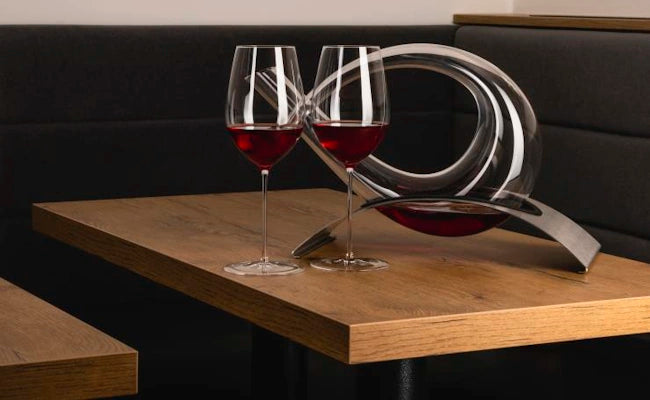
8. WHAT IS THE RIGHT GLASS?
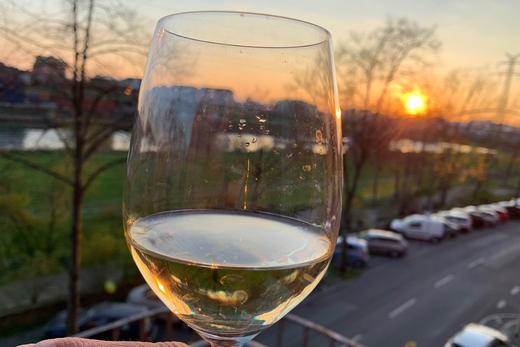
Opinions and personal tastes vary widely when it comes to choosing the right wine glass. There are different wine glasses for almost every grape variety. Undoubtedly, the different shapes influence the wine's presentation, but we want to tone down this technical jargon a bit.
We would like to present you with some suggestions and facts.
- The larger and more bulbous the glass, the more fragrance/aroma is extracted from the wine.
- Use a wine glass with a thin glass wall. This greatly influences the sensory experience, but also the visual appeal of the glass. As they say, we taste with our eyes, too.
- Use a glass that is not too small for white wine and a slightly larger one for red wine.
If you follow these simple tips, you can't really go wrong when choosing the right wine glass.
9. WHICH WINE GOES WITH WHICH FOOD?
The structure of the wine serves as a criterion for selecting the right wine to accompany the meal.
Does the body of the wine complement the richness of the food, and vice versa? For example, a light white wine goes well with fish dishes, and a full-bodied red wine with beef.

Written by Wolfgang Angeli

Leave a comment
This site is protected by hCaptcha and the hCaptcha Privacy Policy and Terms of Service apply.